
Listen
Understand business and operational needs, people, and context.
Firsthand operational understanding, collaborative requirements development, and disciplined architecture guide decisions from initial need through implementation planning.
LASER describes how Swope Consulting approaches the progression from operational need to solution architecture and technology recommendation. It is a guiding framework, not a rigid sequence.
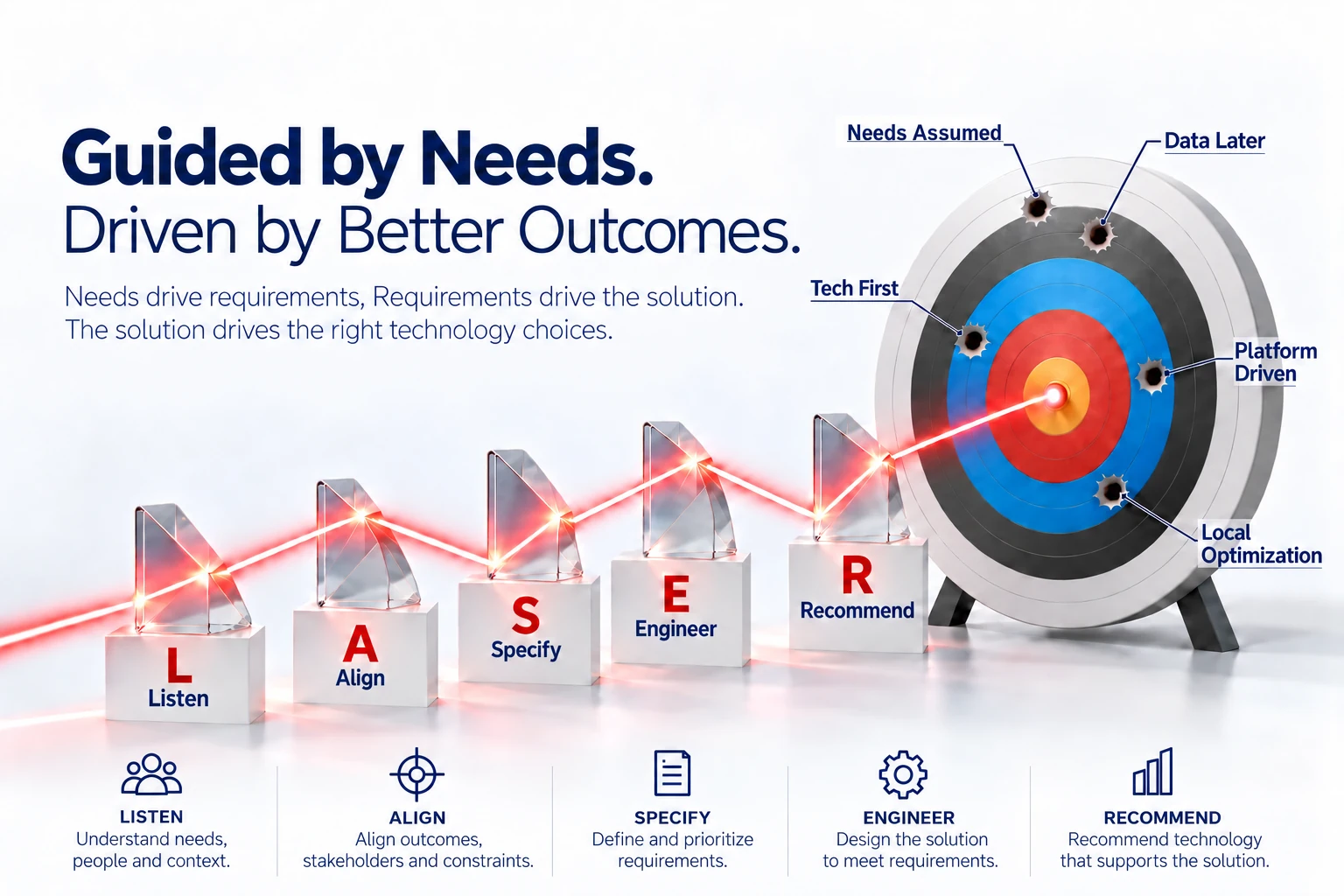
Understand business and operational needs, people, and context.
Align stakeholders, goals, and constraints.
Define and prioritize clear requirements.
Design the solution to meet requirements.
Recommend technology and a practical implementation roadmap.
Sound architecture depends on how manufacturing actually operates, not only how its systems appear in documentation.
When justified by the engagement, an initial visit can combine manufacturing walkthroughs with several days of focused, in-person stakeholder workshops. These conversations and observations help reveal operational constraints, dependencies, and workarounds that might otherwise be missed.
Workshops bring manufacturing, engineering, quality, maintenance, business, and technology stakeholders into the same discussion to challenge assumptions and resolve differing perspectives. Follow-up analysis, design, and additional workshops can be performed virtually where appropriate.
Multi-site manufacturers need shared standards without unnecessarily constraining their facilities. Common architectural patterns, reusable capabilities, data definitions, and integration boundaries should coexist with justified local variation and resilient plant execution.
System responsibilities and dependencies should support manufacturing continuity, including circumstances when enterprise services or connectivity are unavailable.
Anticipated changes in manufacturing processes, business needs, capabilities, and integrations should influence architectural decisions. That does not mean designing every conceivable feature into the first implementation.
The objective is to establish sound boundaries and extensibility so probable future changes do not require excessive rework.
Roadmaps should recognize dependencies, operational readiness, implementation risks, and opportunities to deliver value progressively. Architecture reviews and governance provide guardrails while allowing adjustments as new information emerges.
The scope and approach depend on the decisions you need to make.